
In industrial piping systems, flanges serve as critical connection components, and their standard specifications directly impact the system’s safety and compatibility. This standard is further subdivided into Series A and Series B based on structural design, dimensions, and pressure-bearing capacity. The two series exhibit significant differences in design and application scenarios. This article will provide an in-depth analysis of their core distinctions to assist industry professionals in making precise selections. Understanding these differences is crucial for piping engineers and procurement personnel to make accurate selections.
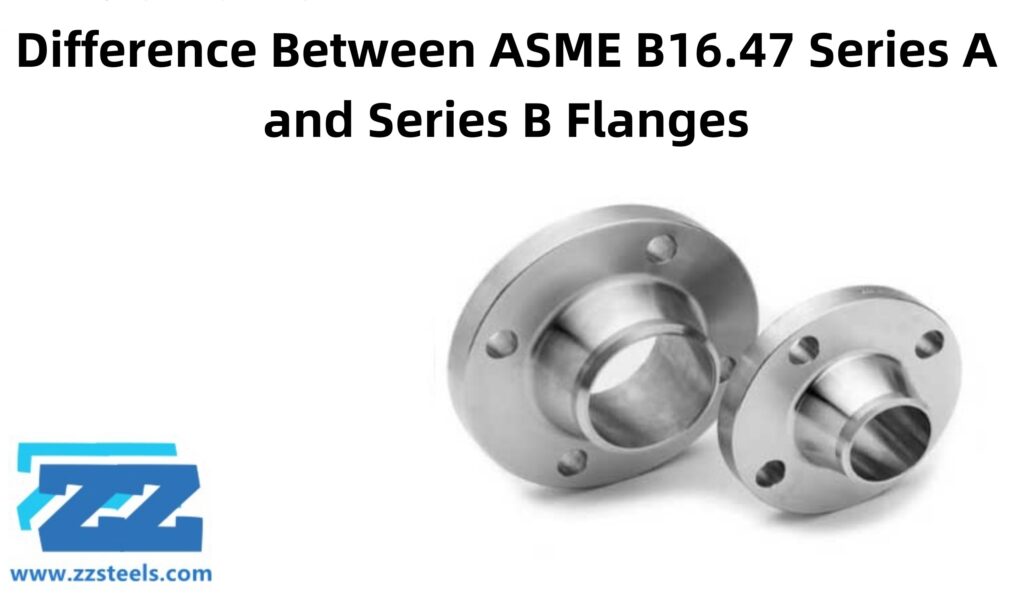
ASME B16.47 Standard
This Standard covers pressure-temperature ratings,materials, dimensions, tolerances, marking, and testing for pipe flanges in sizes NPS 26 through NPS 60. Included are flanges with rating class designations 75, 150, 300,400, 600, and 900 with requirements given in both SI(Metric) and U.S. Customary units, with diameter of bolts and flange bolt holes expressed in inch units.
This Standard is limited to
(a) flanges made from cast or forged materials
(b) blind flanges made from cast, forged, or plate mate-rials (see Tables 1 and 2)Also included in this Standard are requirements and recommendations regarding flange bolting, flange gaskets, and flange joints.
Flange Series
This Standard provides two series of flange dimensions. Series A specifies flange dimensions for general use flanges. Series B specifies flange dimensions for compact flanges that, in most cases, have smaller bolt circle diameters than Series A flanges. These two series of flanges are, in general, not interchangeable. The user should recognize that some flanged valves, equipment bolted between flanges, and flanged equipment may be compatible with only one series of these flanges.
ASME B16.47 Series A and Series B
Series A (derived from API 605): Series A flanges originate from the American Petroleum Institute (API) API 605 standard, originally designed for high-pressure industrial pipelines in the petroleum and natural gas industries. Its dimensional parameters are highly compatible with the API standard system, making it widely used in high-pressure pipeline systems in the energy and chemical industries across North America, particularly suitable for applications with nominal diameters of DN200 (8 inches) or larger and higher pressure ratings.
Series B (MSS SP-44 Extension): Series B flanges are developed based on the MSS SP-44 standard of the Manufacturers Standards Society (MSS), with a design focus on versatility and cost-effectiveness. Its dimensional system offers stronger compatibility with traditional industrial pipelines, making it more widely used in international markets outside North America (such as Europe and Asia) and in medium-to-low-pressure pipeline systems. It also covers nominal diameters of DN200 and above, but offers a cost advantage in low-pressure applications.
Standard Origin
A Series: Derived from MSS SP-44.
B Series: Based on API 605.
Wall Thickness
A Series: Thicker flange bodies provide higher mechanical strength.
B Series: Thinner structure, suitable for medium loads.
Weight
A Series: Heavier due to increased thickness and number of bolts.
B Series: Lighter, easier to handle during installation.
Bolt Hole Diameter
A Series: Typically smaller bolt holes.
B Series: Larger bolt holes, typically requiring wider gaskets.
Bolt Quantity and Configuration
A Series: More bolt holes to enhance sealing and strength.
B Series: Fewer bolts to minimize cost and weight.
For example, in a DN300 (12-inch), Class 150 flange, Series A uses 8 bolts, while Series B requires only 6, making them incompatible for direct interchange.
Available Flange Types
A Series: Series A includes weld neck and blind flanges, which are commonly used in industries requiring high-pressure and critical applications.
B Series: Series B also includes weld neck and blind flanges, making it versatile for various applications.
Pressure Ratings
Series A: Series A flanges have pressure ratings of 150, 300, 400, 600, and 900. These ratings are suitable for high-pressure applications.
Series B: Series B flanges have lower pressure ratings, typically 75, 150, 300, 400, 600, and 900. These ratings are suitable for applications with lower pressure requirements.
Size Range
A Series: ASME B16.47 Series A covers flange sizes ranging from 26 inches to 60 inches. This makes it suitable for applications that require larger diameter flanges.
B Series: Series B covers flange sizes ranging from 26 inches to 60 inches, similar to Series A.
Sealing Surface
A Series: The sealing surface design of the A Series prioritizes high-pressure sealing performance,
B Series: The B Series excels in sealing efficiency at medium to low pressures.
Cost
A Series: ASME B16.47 A Series flanges are typically more expensive than B Series flanges. This higher cost is often justified due to their superior pressure handling capabilities and strict manufacturing and quality control requirements necessary for high-pressure standards. While they may be more expensive, they offer greater safety and reliability, which is critical in applications where failure consequences are severe.
B Series: ASME B16.47 B Series flanges are typically more cost-effective. They are ideal for applications where budget is a primary consideration and pressure requirements are less stringent. Choosing the B Series can save costs without compromising the integrity of the entire system.
Installation and Maintenance of ASME B16.47 Flanges
Installation Precautions
Confirm that the flange series, size, and pressure rating match the pipeline.
Tighten bolts evenly to avoid local stress concentration.
Use appropriate gaskets to ensure sealing performance.
Maintenance and Inspection
Regularly check the tightness of bolts.
Check the flange surface for corrosion or damage.
Replace aged gaskets to ensure long-term sealing.
How to Choose?
Based on the above differences, the selection of either series should be based on specific operating conditions:
Series A is the preferred choice for the following scenarios: high-pressure (Class 600 and above), high-temperature (above 300°C), and pipeline systems that transport corrosive or flammable and explosive media (such as natural gas and chemical raw materials), as well as engineering projects in North America that comply with API standards.
Preferred applications for Series B: Medium to low pressure (Class 300 and below), ambient temperature conditions, such as municipal water supply and drainage systems, general industrial cooling water pipelines, or systems in international engineering projects adhering to MSS standards, which can reduce procurement and installation costs.
Important notes: The two should not be used interchangeably. If both Series A and Series B flanges are present in a pipeline system, they must be connected via transition fittings; otherwise, seal failure or structural damage may occur.
| Feature | Series A (MSS SP-44) | Series B (API 605) |
| Flange Outer Diameter | Larger | Smaller |
| Number of Bolts | More | Fewer |
| Weight | Heavier | Lighter |
| Cost | Higher | Lower |
| Pressure Rating | Higher | Lower |
| Typical Application | High-pressure, high-risk, critical pipelines | Low to medium pressure, cost-sensitive projects |
| Interchangeability | No | No |
Conclusion
The differences between ASME B16.47 Series A and Series B flanges stem from their design backgrounds, manifesting in dimensions, pressure compatibility, and application scenarios. Series A excels in high-pressure and high-strength applications, making it suitable for demanding industries such as energy; Series B, on the other hand, stands out for its cost-effectiveness and versatility, widely used in medium- and low-pressure systems. When selecting flanges, it is essential to consider project standards, medium characteristics, and cost budgets comprehensively to ensure safe and efficient pipeline connections. If you require further information on the specific parameters or application cases of a particular type of flange, please feel free to contact us.